
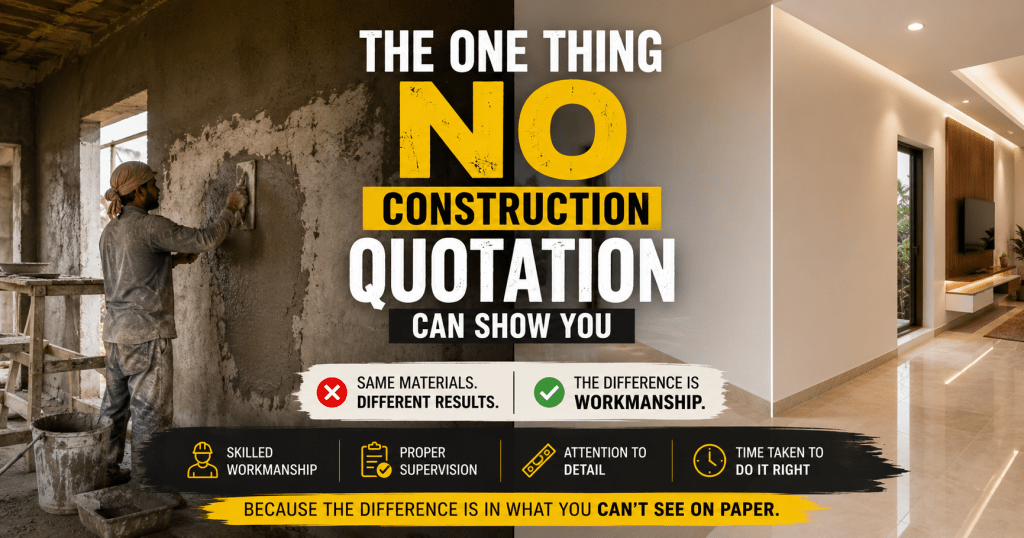
When planning a new home, most homeowners spend a lot of time comparing quotations.
They compare rates per square foot, material specifications, brands, payment terms and inclusions.
And certainly they should.
After all, a construction quotation can tell you the brand of cement, the grade of steel, the type of tiles, the value of sanitary fittings and even the payment schedule.
But there is one thing it can never fully show you.
The quality of workmanship!
And surprisingly, this may have a bigger impact on the final quality of your home than any material mentioned in the quotation.
Same Materials. Different Results.
Let's assume two contractors use the same cement, steel, tiles, paint and sanitary fittings.
Will both houses look the same after completion?
Not necessarily.
Because a home is not simply a collection of materials.
It is the result of how those materials are put together.
The skill of the workers, the attention to detail, the quality of supervision and the time invested in each stage of construction can dramatically influence the final outcome.
The Difference Starts Much Earlier Than You Think
Take masonry work as an example.
Two teams may use the same bricks/blocks, the same mortar and the same drawings.
Yet the finished walls can be completely different.
A skilled mason continuously checks line, level, plumb and alignment. Corrections are made immediately whenever required. The work may progress a little slower, but the quality remains consistent.
A rushed team may complete the same work much faster. Initially, the difference may not be obvious. But as construction progresses, the effects begin to show.
Walls may not be perfectly straight.
Corners may not be sharp.
Additional plaster thickness may be required to correct uneven surfaces.
Small errors made during masonry often become larger problems during finishing.
Good Plastering Is More Than Applying Cement Mortar
Many homeowners underestimate the importance of plastering.
In reality, plastering is one of the most critical stages that determines how your finished home will look.
Proper plastering requires straight walls, sharp corners, uniform thickness, smooth surfaces and adequate curing.
These things cannot be achieved by rushing.
They require experience, patience and craftsmanship.
This is why some homes look elegant and refined even with simple paint colours, while others fail to achieve the same appearance despite using premium paints and expensive materials.
Very often, the difference lies beneath the paint.
The Hidden Cost of Rushing
Quality workmanship requires skilled labour, experienced supervisors and sufficient time to do the work correctly.
Unfortunately, all three come at a cost.
When a contractor works with very tight margins, there is often pressure to complete projects quickly and control labour expenses as much as possible.
This may lead to fewer supervisors on site, less experienced workers, or construction activities being completed faster than they ideally should be.
The impact may not be visible immediately.
After all, a wall is still a wall and a tiled floor is still a tiled floor.
But construction is a game of details.
A skilled mason may spend extra time ensuring perfect alignment.
A good plastering team may spend additional effort achieving straight walls and crisp corners.
An experienced tile layer may take longer to ensure proper alignment, level differences and consistent joints.
These details may add time and cost during construction, but they make a significant difference to the appearance, durability and overall quality of the finished home.
This is one reason homeowners should be careful when comparing quotations based only on price.
Sometimes, a lower quotation is possible because compromises have been made in areas that are difficult to measure on paper, such as workmanship, supervision and finishing quality.
And unfortunately, these are often the very things that become most noticeable after the house is completed.
Why Quotations Cannot Capture Workmanship
A quotation can specify material brands.
It can mention the value of tiles and sanitary fittings.
It can define the scope of work in great detail.
But it cannot accurately show the skill of the people who will execute the work.
It cannot show how carefully the walls will be built.
It cannot show how much attention will be given to finishing details.
And it cannot show how committed the contractor is to delivering a truly well-finished home.
This is why two quotations that appear similar on paper can produce completely different results in reality.
What Should Homeowners Do?
Before selecting a contractor, don't just compare rates and specifications.
Visit some of their nearby completed projects.
Look closely at the finishing quality.
Check the straightness of walls.
Observe tile alignment and joint consistency.
Examine corners, edges and overall detailing.
Ask who supervises the project.
Ask how quality is monitored during construction.
Most importantly, ask to see projects that were completed a few years ago, not just projects currently under construction.
Because true workmanship stands the test of time.
Before You Make Your Decision
Materials matter.
Specifications matter.
But workmanship is what brings everything together.
The best materials in the market cannot compensate for poor execution.
On the other hand, skilled workmanship can elevate every aspect of a home and create a finish that homeowners continue to appreciate for years.
So when evaluating a construction quotation, don't focus only on what is written on paper.
Also think about the one thing that no quotation can fully show you.
The quality of workmanship.
Because long after the brands of cement, steel, tiles and paint are forgotten, the workmanship is what you will continue to see and live with every single day.